

 By
By Imagine being an octopus where the female can be thousands of times heavier than the male. 😳
Sounds crazy, right?
Welcome to the bizarre love life of the blanket octopus. 🐙🌊
These open ocean octopuses are famous for their colorful, flowing membranes. But their reproduction is just as wild.
The male is tiny.
The female can be absolutely massive.
And their mating strategy is seriously one of the strangest in the ocean.
😱 The Male Is Tiny. REALLY Tiny.
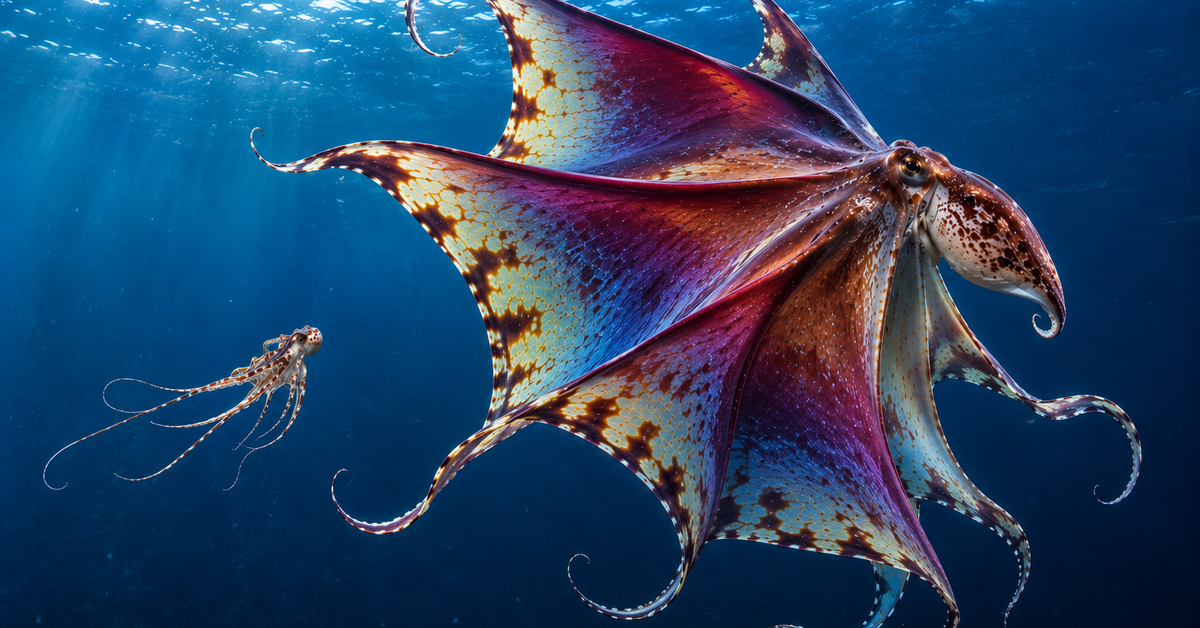
Blanket octopuses (Tremoctopus species) have an extreme difference in size between males and females, known as sexual size dimorphism.
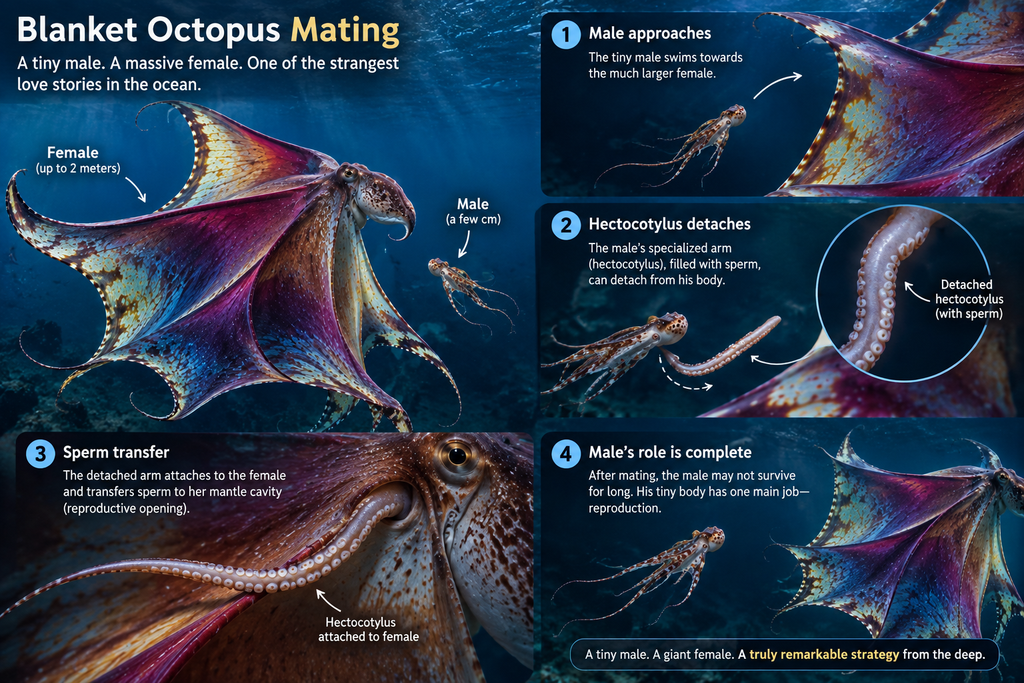
Females can grow to around 2 meters (6.5 feet) in length, while males are only a few centimeters long.
Yep a few centimeters. 😳
The difference is so extreme that the female can weigh thousands of times more than the male.
It’s basically the ocean’s version of “tiny boyfriend, giant girlfriend.” 😂🐙
🐙 So How Does the Tiny Male Mate?
Here’s where things get seriously weird.
The male blanket octopus has a specialized arm called a hectocotylus.
Its main job is to transfer sperm to the female during mating.
And here’s the shocking part:
The hectocotylus can detach from the male’s body during reproduction.
The detached arm carries sperm and is used in the mating process with the female.
That’s one heck of a reproductive strategy. 💀😂
🤯 Why Is the Female So Much Bigger?
The huge difference in size is believed to be connected to reproduction.
Female blanket octopuses need to produce and carry eggs, so their much larger bodies can support their reproductive needs.
Males have a very different role. They mature at a tiny size and invest heavily in reproduction rather than growing into enormous adults.
So evolution gave them two completely different body plans:
Female = giant egg producing octopus.
Male = tiny sperm delivery specialist.
Nature can be seriously weird. 🧬🐙
🌊 And What’s That Giant “Blanket”?
The female blanket octopus has another incredible feature large membranes that can spread between some of her arms.
When these membranes are extended, they create a dramatic, blanket like appearance.
That’s where the animal gets its name.
These membranes can also be used as part of a defensive display, making the animal appear much larger when threatened.
Imagine seeing that thing suddenly spread out in the deep ocean. 😳🌊
🦈 There’s Another Crazy Defense
Blanket octopuses have also been observed carrying Portuguese man-of-war tentacles.
Yep, you read that right. 😱
They can use pieces of these stinging tentacles as a defensive weapon against predators.
The octopus appears to be able to handle the stinging cells without being harmed in the same way a potential predator might be.
So this animal has a giant flowing “blanket,” a tiny male, and a stolen stinging weapon.
You couldn’t make this stuff up.
🧬 One of Nature’s Wildest Size Differences
The blanket octopus is a perfect example of how dramatically males and females can evolve differently.
The female can become enormous, while the male remains tiny.
This extreme difference isn’t just about appearance it’s closely connected to their reproductive biology and how each sex invests in reproduction.
And that’s what makes the blanket octopus so fascinating.
It’s not just another weird looking ocean animal.
Its entire life strategy is seriously unusual. 🐙🌊
🌊 Final Thoughts
The tiny male blanket octopus has one of the strangest reproductive strategies in the animal world.
Females can grow to around 2 meters, while males remain only a few centimeters long. The male uses a specialized arm called a hectocotylus to transfer sperm, and that arm can detach during reproduction.
Add in the female’s giant membranes and her ability to use stinging tentacles defensively, and you’ve got one seriously bizarre ocean creature.
The ocean is full of animals that sound like science fiction.
Nature doesn’t always play by the rules.
Sometimes, it just gets ridiculously creative. 🐙🌊